
Muscle Minute TUESDAY – Small but significant Supraspinatus
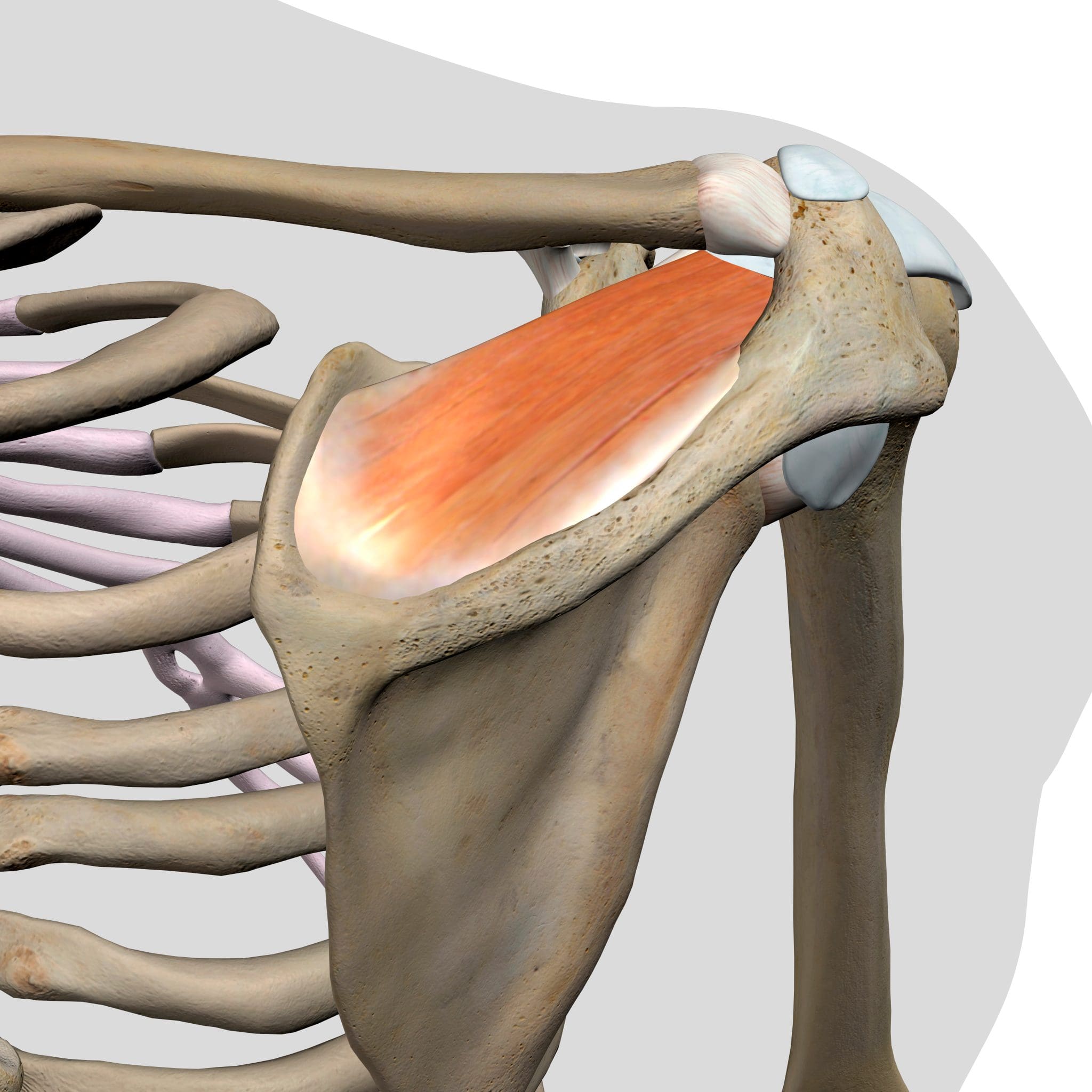
The supraspinatus is the most often insulted rotator cuff muscle, most often affecting people over the age of 60. It is a tiny muscle that can cause a lot of grief so its worth a closer look. Let’s dive in…
| Origin | supraspinous fossa (scapula) |
| Insertion | superior facet greater tubercle (humerus) |
| Action | shoulder abduction; stabilization of humerus |
| Innervation | suprascapular n. (C5, C6) |
| Antagonists | teres major |
The Real World Supraspinatus
What makes this muscle long/weak? In studying overuse injuries, it is helpful to remember that muscles get injured when placed in chronically long/weak positions. Though this muscle acts on the humerus, it is the position of the scapula that often places it in jeopardy. Let’s look at what can make it long/weak:
- Scapular upward rotation – Look closely at the picture above. Can you see how upward rotation could cause this muscle to be lengthened? Trigger points in the upper trapezius, serratus anterior and/or infraspinatus (inferior angle) may biomechanically weaken the supraspinatus.
- Scapular adduction – Scapular adduction, caused by tightness in the rhomboids, may also weaken the supraspinatus.
- Scapular depression – Scapular depression most often happens with gravity, but a tight pec minor or inferior portion of the serratus anterior may place tension on the supraspinatus.
Positional overuse. I just made that term up, but it is a real thing. With the arm in the dependent position (arm by side), the supraspinatus should be virtually silent. This is mostly due to the position the scapula should be in at rest: slight upward rotation and slight protraction. If the scapula is downwardly rotated (tight pec minor or rhomboid), the supraspinatus has to remain active in this position to suspend the humeral head in the glenoid fossa, creating a postural overuse scenario. You can overuse the supraspinatus by not moving at all.
Here’s a short list of why this matters:
- Most supraspinatus tears happen insidiously, linking it primarily to postural asymmetry
- The strength of the supraspinatus can change immediately by correcting the position of the scapula. Give it a try. Resist shoulder abduction and if painful, look for the trigger points listed above. Treat any that you find. Then retest shoulder abduction.
- Irritation of the supraspinatus results in swelling of the tendon. The tendon rides underneath the acromion between 90˚-120˚ of arm elevation and if swollen may be impinged. Chronic impingement can lead to tears.
Conventional thinking says: When the supraspinatus is injured, strengthen abduction of the shoulder.
Real World Thinking asks: The supraspinatus is often injured due to abnormal positions of the scapula which place it in long/weak positions or in positions of postural overuse. Take the time to palpate for key trigger points in the pec minor, upper trapezius, serratus anterior, infraspinatus and rhomboid. Fix what you find for a healthier supraspinatus.
Because nobody has time to be in pain.
Until next time…