

Kinesiology THURSDAY – What’s the big deal about Trigger Points
Trigger points (TrP) are defined as palpable nodules located in the myofascial layer primarily at the entrance point of the motor endplate in a muscle belly. They are typically 2-10mm in length and occur in muscles that are in a chronically short position. Combined with the concept of Sherrington’s Law of Reciprocal Inhibition, which states “when one set of muscles is stimulated, muscles opposing the action of the first are simultaneously inhibited”, trigger points have a story to tell that may be invaluable to solving complex orthopedic biomechanical problems and lead us to successful options for treating muscuoskeletal injury and pain.
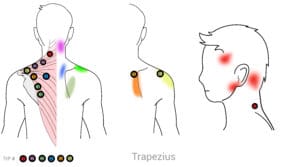
Trigger points don’t just occur because a muscle decided to become tight. They occur because of prolonged abnormal posturing and/or lack of proper movement. They also tell us which muscles may be long/weak (the functional antagonists) and how a joint may be functioning or not functioning correctly in all three planes of motion. Let’s explore a common example from the upper extremity.
Upper trapezius trigger points are commonly associated with rotator cuff tendonitis and impingement, cervical compression syndromes and tension headaches. The upper trapezius elevates and upwardly rotates the scapula. It becomes hyperactive in forward head posturing as it actively supports the cranium. The antagonist to the upper trapezius, the lower trapezius, is placed in a long/weak position with an increase in thoracic kyphosis and may further be inhibited with an upper trapezius trigger point.
It is common for clinicians to address upper trapezius tightness with direct techniques such as trigger point massage and stretching, which often yields temporary results. But ask yourself this. How can we support the manual technique with a movement-based program based on the properties of trigger points and the principle of reciprocal inhibition? We need to listen to the story the trigger points are telling us.
Activate the lower trapezius
The lower trapezius is the functional antagonist to the upper trapezius. If it is long/weak, the upper trapezius will be short/tight. The lower trapezius becomes long and weak in the presence of a thoracic kyphosis. This muscle is also best activated with arm elevation past 90˚.
- Wall washing and dumbbell overhead presses are excellent ways to activate the lower trapezius with arm elevation.
- Sitting thoracic extension movements (STEMs) are effective in decreasing thoracic kyphosis.
- Foam roll alternating arm flexion helps stretch out the latissimus dorsi, a common cause of thoracic kyphosis.
Correct an elevated shoulder girdle
An elevated shoulder girdle is often caused by an elevated pelvis on the same side. This is confirmed by a TrP in the quadratus lumborum (QL). The wall wash and triangle pose exercises are excellent solutions to lengthening a QL and leveling the pelvis. This will then level the shoulders.
Decreased thoracic rotation can also cause an elevated shoulder girdle. The side lying angel stretch or the tubing 90/90 pull will help restore normal thoracic rotation.