
Muscle Minute TUESDAY – Meet the Transverse Abdominis
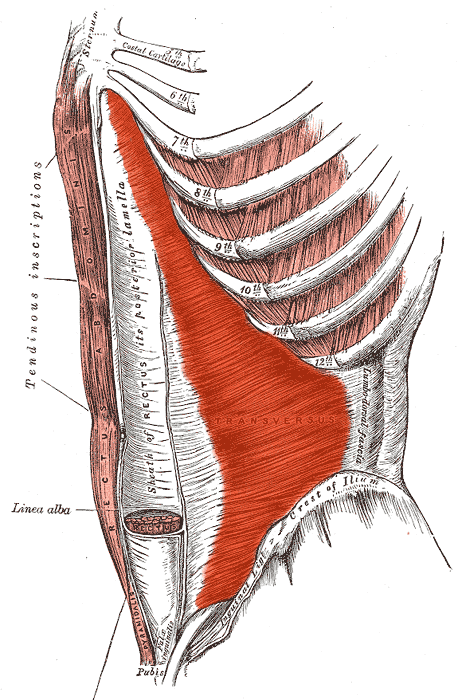
“How do I get rid of this belly?” people have asked me. And my reply is, “Can you suck it in?” Because if you can suck it in, that isn’t fat. That is a long, weak transverse abdominus (TrA) muscle. Intrigued? Let’s dive in…
| Origin | iliac crest, inguinal ligament, thoracolumbar fascia, 7-12 costal cartilage |
| Insertion | xiphoid process, linea alba, pubic crest |
| Action | compresses abdominal contents, stabilizes lumbar spine |
| Innervation | thoracoabdominal nn., (T6-T11), subcostal n. (T12), iliohypogastric n. (L1), ilioinguinal n. (L1) |
| Antagonists | iliopsoas |
The Real World Transverse Abdominus
As the deepest abdominal layer and with its connection to the thoracolumbar fascia, the TrA is uniquely positioned to work in concert with the multifidus (the deepest spinal muscle) to stabilize the lumbar spine. This study indicates three interesting facts:
- Increased TrA activation with increased center of mass. In other words, the higher you lift your arms, the greater activation. It was the only abdominal muscle that increased activation as you raised your arms.
- The heavier you lift, the more active TrA becomes, activating 24-40 ms prior to the deltoid.
- The TrA becomes more active with trunk flexion moments, as occur when you lift your arms in front (flexion) or if you lift your arms behind (extension).
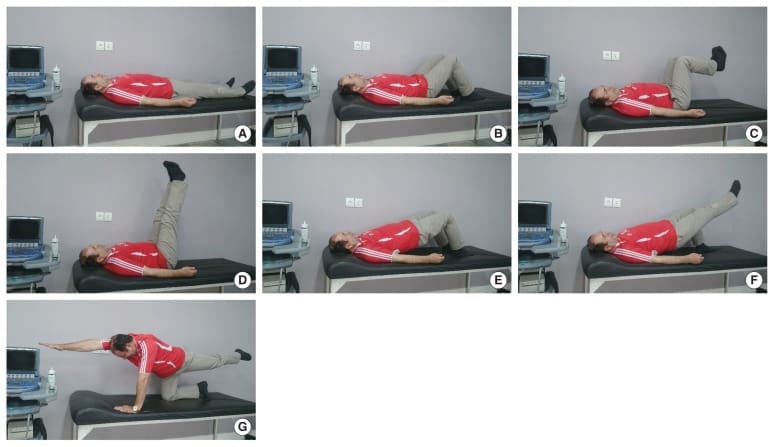
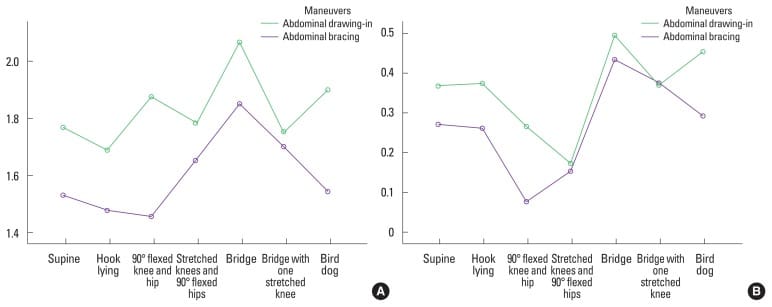
Other studies have indicated TrA is more active in sitting or standing positions, versus hooklying or supine. The TrA is a stabilizer and does not activate well in stabilized positions. In a study comparing mostly supine exercises, the TrA activated most while the subject performed abdominal drawing in maneuver during bridging. It’s interesting that during the bird dog exercise (G), the activation dropped, coinciding with the previously mentioned that the TrA is more active when flexion moments are exacted on the spine (versus extension).
Here’s a short list of why this matters:
- Individuals with low back pain have decreased TrA activation, indicating the sigificant role this muscle plays in lumbar stabilization
- The less stable an environment, the more this spinal stabilizer is activated: standing v. lying down; moving your arms higher, faster arm movement
- Teach your patients to draw-in their belly button towards their spine for maximum activation.
You are no longer tied to abdominal activation with isolated trunk movements. Activate this belly-flattener by standing, picking up some dumbbells (or use tubing) and lifting them in front of you quickly. It will save you time and maybe even a backache. Kind of like this, only way quicker and with a little more excitement.
Conventional thinking says: Work the abdominal muscles with crunches and sit-ups
Real World Thinking says: Activate the most important stabilizer of the spine by moving your arms quickly and overhead in the standing position. Stabilizers work best in unstable conditions.
Because nobody has time to be in pain.
Until next time…

Kind Regards,
MoveWell Academy
[email protected]