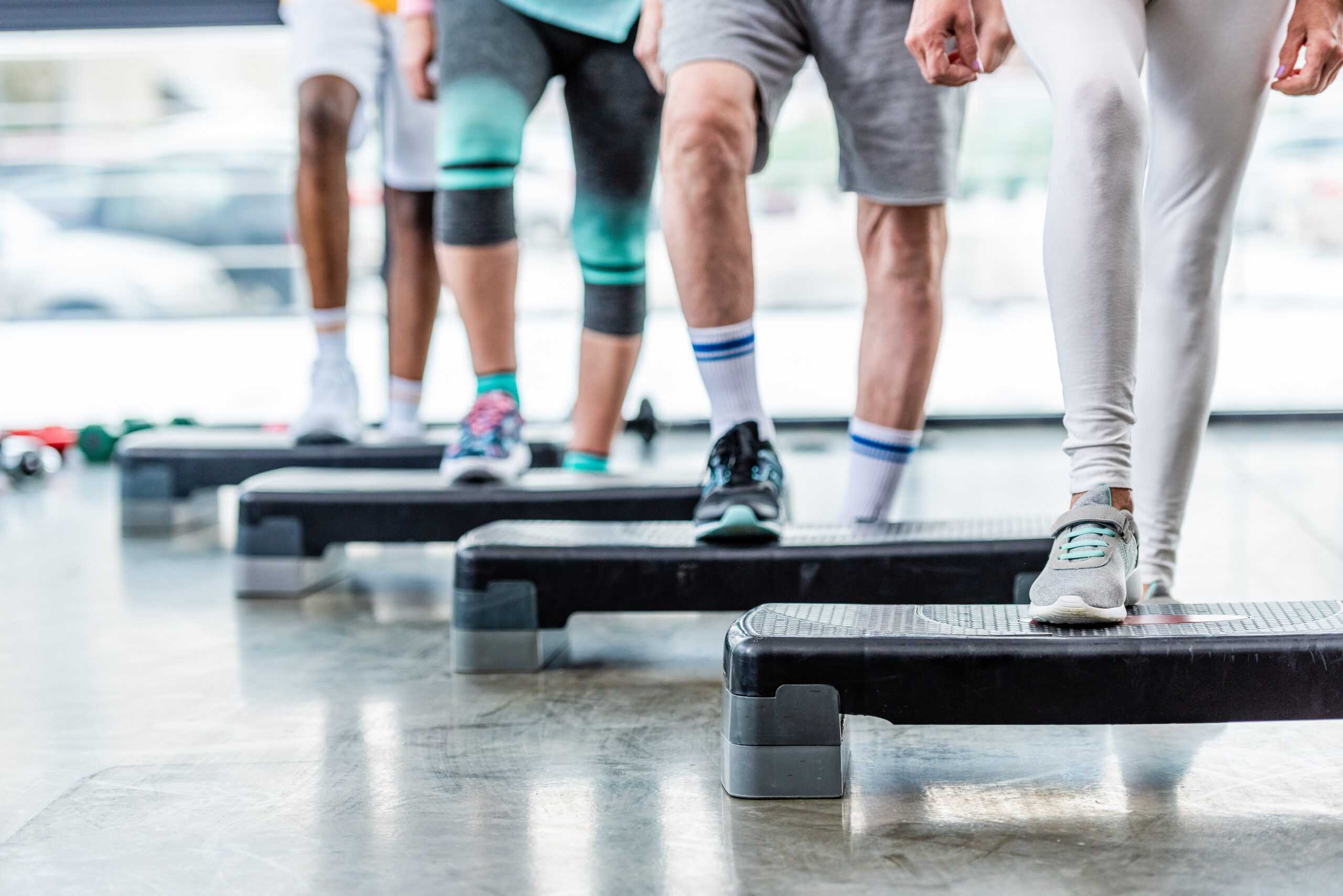
Kinesiology THURSDAY – 8 Hardest Moves After 60 – Stepping Up
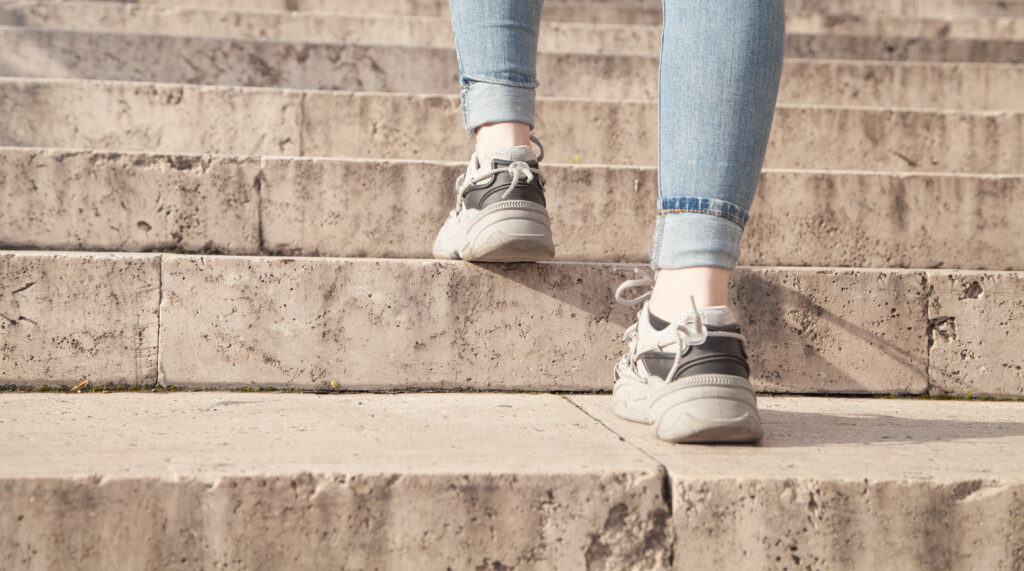
Young woman walking up the stairs in city.
You do it dozens of times a day without even noticing. Stepping onto a curb. Climbing stairs. Walking up a slope. Getting into a vehicle.
Then one day, something changes. You begin using the railing more, leading with the same leg every time and avoiding steps whenever possible. You may notice having to pull yourself up using the railing. What used to feel automatic suddenly takes effort and that matters more than people realize.
Many people assume this is from normal aging, But often, it’s simply a sign that the body needs more strength and balance training.
Kinesiology of Stepping Up
Stepping up Is a full-body strength and balance test. It sounds simple, but it is actually one of the most demanding everyday movements requiring: single-leg strength, balance, coordination, hip stability and core control.
When you place your foot on a step, the following must occur:
- 15˚-30˚ ankle dorsiflexion
- Subtalar joint eversion to allow for single leg balance
- 85˚-120˚ knee flexion. And the knee should be in line with and slightly behind the second toe
- Gluteus medius activation to maintain level pelvis
- Quadricep strength to extend the knee
- Gluteus maximus strength to extend the hip
- Trunk rotation and opposite arm swing (this enhances gluteus maximus activation)
These six things allow for a single leg squat, which is what going up steps requires. Walking down steps requires greater quadricep activation and higher ranges of ankle dorsiflexion and knee flexion to perform as the hip is less flexed, decreasing activation of the gluteus maximus.
Hands-On Techniques to Improve Stepping Up and Down
If you want to help your patients navigate steps more efficiently, perform the following:
- Mobilize the subtalar joint to improve eversion. Releasing trigger points on the medial lower leg (posterior tibialis and medial gastroc) helps
- Mobilize the talocrural joint posteriorly to improve dorsiflexion
- Release trigger points in the adductor. Trigger points in one muscle will neurologically weaken its antagonist. A tight adductor will inhibit the gluteus medius
Real World Exercise
- Posterior step downs – stand on the lowest step of your stairs. Bend your right knee and tap your left foot to the floor and then straighten your right knee and return to the starting position. Make sure not to push off the toes of your left foot to get back to the start. Perform 10 repetitions and then repeat while standing on the left leg.
- Single leg mini-squats – stand on one leg. Perform mini-squats at 1 per second while maintaining balance. Perform for 30 seconds.
- Mini-band lateral stepping – Place a mini-band around your ankles. Step sideways for 10 repetitions leading with the right leg, maintaining tension in the band (don’t leg your feet come all the way together). Then reverse directions and lead with the left leg.
Weekly Goal
Go up and down a flight of stairs at least once a day. If you live in a ranch style home, find a curb and practice stepping up and down leading with each leg. Remember, try not to push off the back leg. Make the front leg do most of the work.
Why does this matter?
This movement affects far more than stairs. It impacts your ability to navigate curbs safely, get into cars, walk uphill, carry groceries and move confidently in public spaces. When people begin struggling with stepping up, they often start limiting where they go. That’s how mobility loss quietly changes daily life.
Movement practice helps break that cycle. So go find a flight of steps and remind your body of this important lesson.
Next, we’ll cover a movement most people never think about—until it causes a fall: turning and changing direction. Moving safely isn’t just about going forward. It’s about staying stable when life pulls you sideways. I’ll see you here next week.
Because nobody has time to be in pain.
Until next time…

Kind Regards,
MoveWell Academy
[email protected]